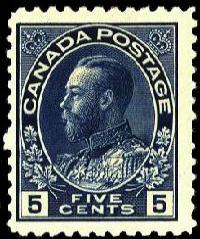
 Indigo |
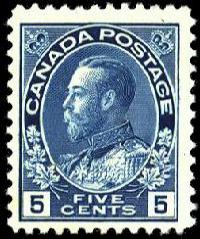 Grey Blue |
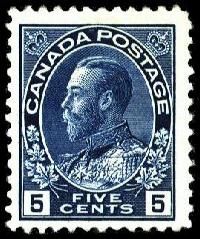 Dark Blue |
The five-cents value was issued in sheet format only, from a total of 14 plates. See Summary for details on the plates.
The seemingly large quantity printed, considering its intended purpose as payment for the first ounce on foreign letters, is explained by the use of this issue for fiscal purposes, that is, to pay taxes and such. When used for fiscal purposes, it was overprinted WAR TAX or INLAND REVENUE WAR TAX.
Only one master die was used in the making of the plates for the five-cents value, but it was worked on a number of times, which resulted in there being three readily disinguishable variations, or types, which are identified by differences in the vertical lines of the left numeral box.
The earliest printings of the five-cents value were of a very deep shade of blue that is commonly referred to as indigo. Printings from the same plate are also found in a much paler shade, although not as light as, for example, the eight-cents blue. This paler shade of blue is usually called grey blue. The later printings from Plates 11 to 14 are of a darker shade, but not as dark as the earlier indigo printings. This shade is referred to simply as dark blue.
Indigo |
Grey Blue |
Dark Blue |
This issue is considered to have only one major re-entry. It is from Plate No. 8, and is evidenced by a doubling of the left vertical frame line as well as in the lettering of CANADA POSTAGE.
There are numerous retouches, including the common strengthening of the vertical line in the upper right spandrel. Those desiring a more detailed explanation of the retouches are advised to consult George Marler's book Canada: The Admiral Issue (see References).
Updated: 13 Oct 97