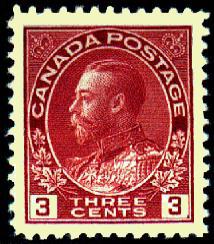
 Die I |
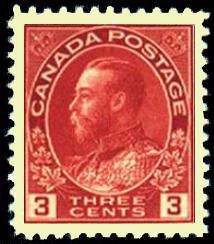 Die II |
 Die I Detail |
 Die II Detail |
The carmine three-cents Admiral stamp, which was issued as a result of a change in postal rates and the need to conform to the conventions of the Universal Postal Union with respect to the standardization of colours, was printed in three formats: sheets, booklets and coils. Two additional varieties of format were also produced, a perf 12 x 8 version of the sheet form, and a part perforate version of the coil form.
Sheets were printed from plates numbered from 115 to 176, although it is believed that Plates 118 to 120 were used only in the printing of the three-cents brown issue. (See Summary for details.) Only the Dry process was used. (See Methods of Printing.)
Die I |
Die II |
Die I Detail |
Die II Detail |
Shades. Besides the normal carmine shade, only one other exists, a scarce rose carmine shade from the Die I printings, which appeared about 1923.
The Imperforate SheetsAs were the one-cent yellow and two-cents green, the three-cents carmine was also issued in imperforate form. It was made available to the public through the Philatelic Agency on 23 January 1924, but was not sold through post offices. Plates 126 to 131 (Die I) were used in the printing of 100,000 copies, using the Wet process. There are no significant shade variations. |
 Imperforate |
The second printing, which was done by the Canadian Bank Note Company was arranged because the first, which was printed by the King's Printers, was considered to be of poor quality. Unfortunately, the quality of the second printing turned out to be much the same as the first.
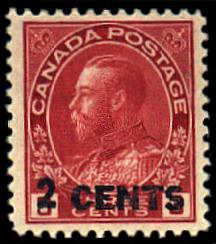 Type 1 Overprint |
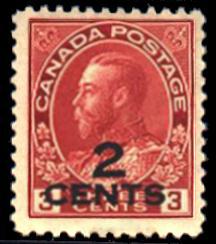 Type 2 Overprint |
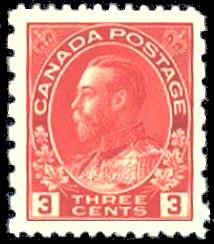 Perf 12 x 8 |
Sheets (Perf 12 x 8)An increase in rates in 1931 saw a sudden resurgence in the need for a three-cents stamp. While a new die was being made for increased printings of the three-cents value in the Scroll Issue, the Canadian Bank Note Company arranged the supply of three-cents coil stamps in sheets of 100, perf 8 vertically, which were then perforated 12 horizontally. It was issued on 24 June 1931 and was replaced just three weeks later on 13 July by the new issue. |
Updated: 5 Oct 97