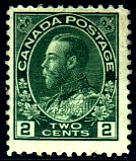
Yellow Green
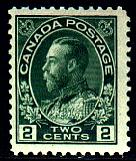
Deep Green
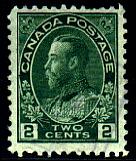
Green
Agreements at the 1920 Universal Postal Union Conference in Madrid, changing postage rates to go into effect 1 October 1921, meant that the two-cents value would henceforth be used to pre-pay the printed matter rate, and accordingly it was necessary to change the colour to green.
Although the issue date was officially 6 June, the stamp is known to have been used as early as 5 April.
The two-cents green was printed in two die states over a total of 71 plates, from 159 through 229. All were in 400 subject plates, Type D (see Formats). See Summary for more details.
Unfortunately, there is no single easily recognisable significant factor that can help identify one die from the other. Of the eight types that constitute the retouched second state die, and the three of the re-engraved die, some differences are identified in the composite images below, and will help the specialist identify some of the printings. Again, the authors would refer the reader to the comprehensive work by Marler (see References).
There are many minor retouches and re-entries on the plates, but none considered worthy of catalogue status.
Marler states that two shades exist in the wet printings (green and deep green), and one in the dry (yellow green). Most authorities however appear to recognise only the one wet process shade, along with one dry process shade.
Yellow Green |
Deep Green |
Green |
The vertical wove was the norm for the sheet stamps, but between Plates 182 - 186, stamps will be found printed on a very thin paper which, when viewed from the back, the printed image is very distinct (see Paper).
Earlier printings were by the Wet process. Dry printing commenced on 26 December 1922, but was not used with the two-cents denomination until the end of 1923, at which time Plates 164 - 172 were in use. Wet printing did not end completely until the introduction of the re-engraved die, and all of these were printed by the dry method (see Methods of Printing).
Types C and D are found among the earlier printings, Type C on sheets from Plates 159 - 162, Type D on sheets from 163 - 181, 188 - 189, and 193 - 194. No lathework appeared on sheets from the remaining plates from the retouched, or the re-engraved dies. (See Lathework for an explanation of the lathework types.)
As was the case with the one-cent yellow, the two-cents green was issued on 6 October 1924 in an imperforate form. Printed from Plates 188 and 189, 50,000 stamps were released, all printed by the wet method. There were no retouches or re-entries of note.
Updated: 11 Oct 97