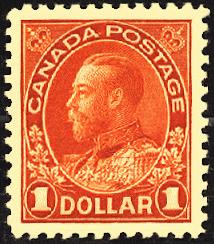
Wet Printing
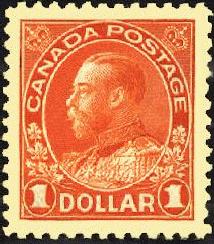
Dry Printing
Date of Issue: 22 July 1923
Quantity: 1,364,955
Method of Printing: Both Wet and Dry printing on horizontally wove
paper.
The first $1 value to be issued since the 1897 Jubilee, it was used for parcels and other large or heavy items.
All of the $1 stamps were printed from the one plate, but both Wet and Dry methods were used (see Methods of Printing). Apart from the usual width differences, the two methods can be even more easily distinguished by the shade variation, the wet being somewhat darker in appearance compared with the dry.
Wet Printing |
Dry Printing |
The plate layout was Type D, an unbroken block of 400 subjects arranged 20 x 20.
Imperforate issues are known of this value, but were never officially issued thus.
As mentioned above, with Unitrade additionally recognising an Orange, and a Brown Orange within the Dry printings. Gibbons lists just the one shade in its Commonwealth Vol 1 Catalogue
There are no noticeable retouches or re-entries.
Type D. (See Lathework for an explanation of lathework types.)
Updated: 5 Oct 97