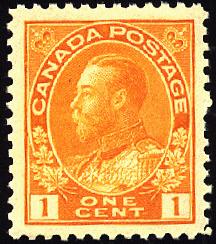
 Die I |
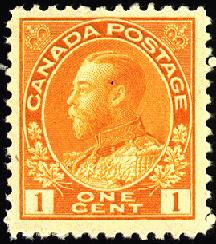 Die II |
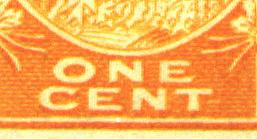 Die I Detail |
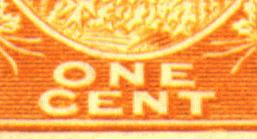 Die II Detail |
The change of colour from green to yellow was necessary to conform with new regulations decreed at the Universal Postal Union in Madrid in 1920. The regulation took effect on 19 October 1921.
The Retouched Die remained in use, and the last two plates, 169 and 170, used for the green stamps were used to print the first of the yellow. These plates were of Type D, that is, 400 subjects (see Formats). Further printings were made from Plates 171 to 187, excluding Plates 183 to 185, all in the same format. (See Summary for detailed information on the various plates.)
At the end of 1924, a new die, to become known as Die II, was introduced, partly because of the intention to change from the "Wet" to the "Dry" method of printing. Early in 1925, the Die II stamps came into use, all printed by the Dry method, but together with a small number from the old Retouched Die, on Plates 186 and 187, similarly printed. Plates 183 to 185, and Plates 188 to 199, all from Type D 400 subject Plates were used up until the end of the Admiral series in 1928. It is interesting to note that, with ever improving quality in the standard of production, that there were no distinctive differences in the Die II printings, whilst the students of the Admiral Issue recognise four types in the earlier Retouched Die printings in yellow.
The differences between the two dies are easy to distinguish, and the main point of identification is the space between the top of the lettering ONE, and the bottom of the portrait frame. In the case of Die I, there a noticeable gap, and in Die II, the letters are nearly touching. The illustrations show this clearly.
Die I |
Die II |
Die I Detail |
Die II Detail |
Only 1,278,760 stamps were printed in yellow, reflecting the fact that there was no longer any First Class or Local Rate of One Cent. The relative scarcity of the Wet printed Die I (Retouched Die) stamp is reflected in current catalogue prices.
Up to four shades of yellow are recognised (by Unitrade), but with Gibbons recognising only the one, Chrome Yellow. Three shades are displayed here: Yellow, Lemon Yellow, and Chrome Yellow.
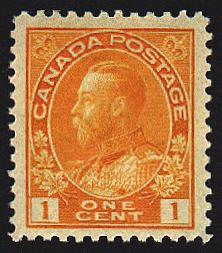 Yellow |
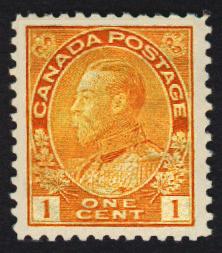 Lemon Yellow |
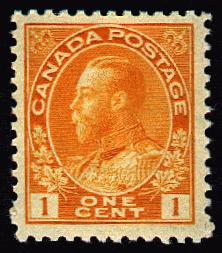 Chrome Yellow |
Types C, D and D inverted are known on sheets from Die I. There is no lathework on the Die II printings. (See Lathework for an explanation of types.)
The Imperforate Sheets50,000 stamps are said to have been released by the Canadian Philatelic Agency in October 1924, Wet printed from Plates 179 and 180. It is believed that others were illicitly released at an earlier date, but the numbers are not known. |
 Imperforate |
Updated: 11 Oct 97