 Wet Printing |
 Dry Printing |
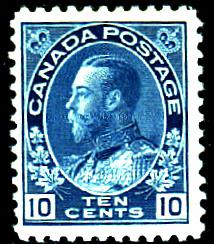
The ten-cents blue was issued in sheet form only, from a total of 10 plates, new ones having been laid down following the ten-cents plum issue. See Summary for details of the plates.
The change in colour from plum to blue stemmed from an increase in the rate for foreign letters from five to ten cents and from the subsequent requirement to conform to the standards of the Universal Postal Union with regards to the colour reserved for foreign rates.
There is only one type.
The only shade variation is due to the usual slightly lighter shading of the Dry process printings. (See Methods of Printing.)
Wet Printing |
Dry Printing |
Some subjects on Plates 21 and 22 show clear evidence of an unusually heavy second impression of the transfer roll resulting in double entries. As one example, the following image shows a thickening or doubling of the bottom line:
 Normal Thickness of Bottom Line |
 Thickening of Bottom Line |
Updated: 25 Apr 01