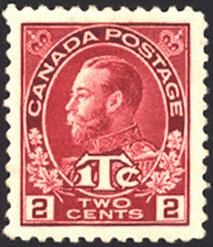
 Die I |
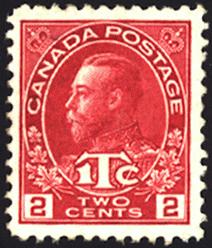 Die II |
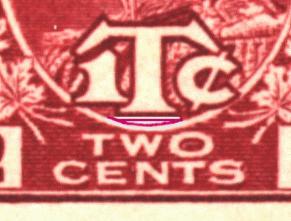 Die I Detail |
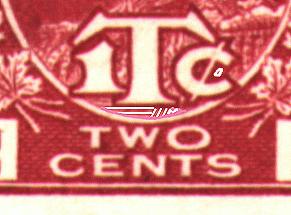 Die II Detail |
The obvious solution to the confusion that had grown over the use of separate tax and postage stamps was to introduce a combined stamp which provided for both elements, and on 7 December 1915, approval was given for a two-cents Carmine with 1Tc incorporated in the design, becoming Canada's first semi-postal issue. A previous exercise, indicating a total of three-cents had been rejected. The Die, which has come to be known as Die I was troublesome, with much work required on the plates, and as early as February 1916, a replacement Die was being engraved. and which was used to cut the first transfer roll at the end of February. The new Die, which became known as Die II, has several distinctive differences, which are indicated in the illustrations below.
Die I |
Die II |
Die I Detail |
Die II Detail |
With the confusion of the charge elements removed by the introduction of the new design, a further category of confusion was introduced, that of colour, with the two-cents Carmine regular issue. This was resolved by changing the new combined tax and postage issue to brown, but before this came about, there were still interesting developments with the carmine issue to consider.
It will be recalled that coil stamps were released in either a vertical, or endwise, format for vending machines, and a horizontal, or sideways, format for stamp affixing machines of the type usually to be found in commercial premises. The new 2+1c. stamp was released in sideways form during the early part of 1916, with 11,500 rolls known to be accounted for in the period ending 31 March 1916.
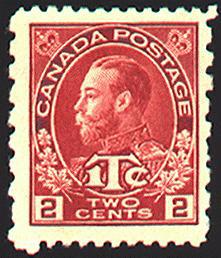 Perf 12 x 8 |
In August 1916, a shortage of the War Tax stamps had come about, probably due to the late arrival of the new Die II printings. The problem was resolved with the use of the as yet uncut, but part perforated sheets that made up the endwise coil rolls, and by perforating them horizontally Perf 12. Thus, the Perf 12 x 8 example came into being. In addition, two 400 subject plates were prepared to print the stamps with this perforation, and were also used for the regular Perf. 12 Post Office Sheets. |
The sheet stamps (Perf 12) were printed in the usual 400 subject plate, and it is thought that the printing totals came to: 166.8 million Die I, from Plates 1 - 14, and 5.5 million of Die II, Plates 15 and 16. The advanced collector recognises three types of the Die I printings, and two for the Die II, the differences being based on plate retouches of aspects of the design. None are distinctive enough to merit catalogue status, and our interest is confined to the two Dies only.
The Perf 12 x 8 stamps, all of which were Die I, totalled 4.8 million, but of course were mainly from the plates set up for the coil printings.
The sidewise coil was printed from four plates in all, with those later adapted as sheet stamps all coming from the first two. 15,315,000 stamps were delivered by the manufacturer. There were no major re-entries.
There is no Lathework to be found on any format of the printings of this stamp.
Updated: 5 Oct 97